
Everyone from weekend home project warriors, to construction workers, to first responders knows that one false step on a ladder can mean serious injury or even death.
From a young age, many of us learn that ladder safety is essential to both the trades and fixing things around your own home.
But using a ladder can quickly become treacherous if you try carrying up a heavier-than-appropriate load, or you miss signs of a ladder defect.
Common fall from ladder injuries can change a victim’s life. If you have been injured in a ladder fall, the Mann Law team may be able to help. Please contact us today or call at (207) 709-0900.
We will explain some of the most common causes of ladder falls and how to get help from a premises injury lawyer. Read on to find out more.
Ladder accidents are surprisingly common in the U.S. and account for hundreds of workplace injuries annually. In the years between 2017 and 2021, falls caused 887 fatal injuries, according to data from the Bureau of Labor Statistics.
Most of these fatalities were from a height to a lower level and were presumed to be ladder falls.
Prevent ladder accidents by using the ladder as intended by the manufacturer. Do not alter or lengthen the ladder. Always maintain three points of contact to ensure stability.
The two main causes of falls from ladder accidents are defective ladders and human error. Defective ladders can result from both manufacturer defects and from using an old, improperly cared for, or damaged ladder.
Another issue that can lead to ladder falls is using the wrong ladder size. Many workplaces have only one or two sizes of ladders.
If this is the case in your workplace, and you are required to stretch or use unsafe practices to reach high objects, this can lead to catastrophic falls.
If this is the cause of your fall from ladder injury, please contact a member of the Mann Law team today. We may be able to help you obtain the compensation you deserve.
As we have discussed, the most common cause of injury on a ladder is a fall.
While there are certainly other ways to injure yourself on a ladder, like snapping a finger in the joint or suffering bodily harm while moving a ladder, the typical cause of a ladder accident is a fall.
A fall from any height, even just a few feet, can cause serious injuries. Falls from significant heights or while carrying heavy objects could cause catastrophic injuries and even death.
Common fall from ladder injuries can range from painful to catastrophic. Even minor fall injuries require emergency room care, as concussion and fracture risk typically must be assessed.
Between 150 and nearly 200 fatal ladder falls occurred each year between 2016 and 2020. That included only the reported ladder falls that were assessed by either medical examiners or emergency room doctors.
However, there were more than 22,000 non-fatal ladder fall injuries in 2020 alone, resulting in injuries ranging from serious to catastrophic.
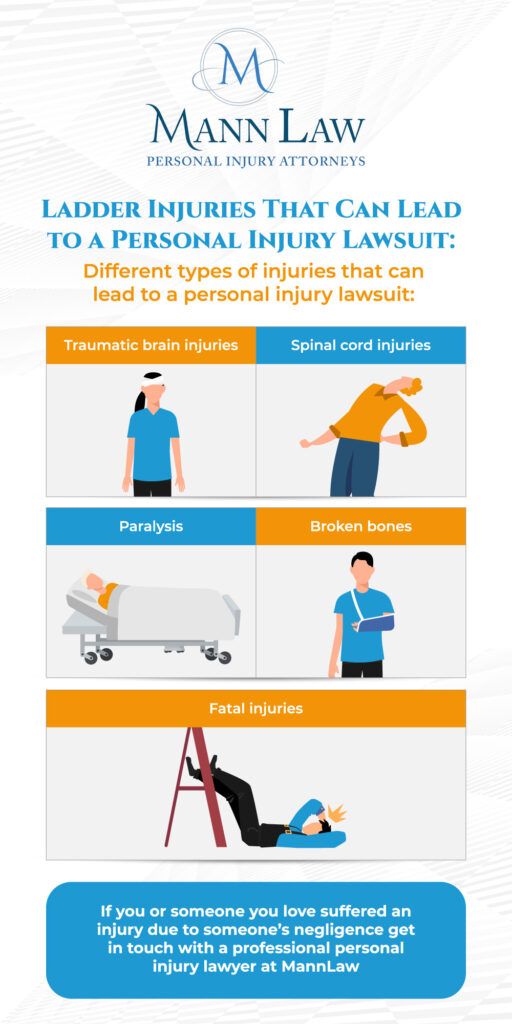
Some serious fall-from-ladder injuries include:
Brain injuries are among the most severe injuries that fall victims can suffer. While a concussion is a less severe brain injury, these can still have lasting impacts on ladder fall victims’ lives.
If you fell off a ladder and landed on your back, it’s crucial to assess for injuries immediately. The impact can lead to severe trauma, even if you’re not initially aware.
If you’re experiencing any pain or difficulty moving, seek help promptly. Avoid moving unnecessarily and try to maintain a stable position until assistance arrives. It’s recommended to avoid attempting to stand up without assistance to prevent further injury.
Catastrophic ladder fall injuries can cause permanent disabilities, and other fall victims do not recover at all. If you or a loved one has been in a ladder fall, either at home or in the workplace, contact Mann Law today.
We can help you understand your options for recovering compensation.
In some cases, a ladder defect from the manufacturer can cause a fall accident. In this case, a victim may have grounds for a product liability claim.
When you need a ladder accident lawyer or premises lawyer to help you navigate your ladder injury claim, contact Mann Law.
Our experienced ladder accident team has innovated a client-centered approach for nearly 20 years. Plus, our extensive knowledge of fall accidents, workplace accidents, and slip-and-fall issues helps us fight for your best interests.
We enjoy being part of the unique Maine community and view our clients as part of our extended family to whom we extend our best service. Contact us today or call us at (207) 709-0900 for help with your claim.
Helpful answers about fall from ladder injuries, what they may involve, and what steps to take next.
Common fall from ladder injuries include head injuries (including concussions), broken wrists or arms from trying to catch yourself,
fractures in the ankle or leg, back and neck injuries, shoulder injuries, and deep bruising or soft-tissue damage.
Seek medical care right away if you have severe pain, dizziness, confusion, vomiting, numbness, weakness, trouble walking,
shortness of breath, or pain that worsens over time. Some injuries—especially head, spine, and internal injuries—aren’t always obvious at first.
Get medical treatment, report the incident (if it happened at work or on someone else’s property), and document the scene.
If possible, take photos of the ladder, the area around it, any wet/slippery surfaces, missing safety equipment, and your visible injuries.
Keep the ladder if it may be defective.
Workplace ladder falls often involve workers’ compensation benefits, but there may be additional options if another company’s negligence,
unsafe property conditions, or defective equipment contributed. A lawyer can help you understand what claims may apply in your situation.
If the ladder failed due to a defect (for example, a faulty hinge, broken rung, or structural failure), you may have a claim against parties in the supply chain.
Preserve the ladder, packaging, and receipts if you have them, and avoid repairs or modifications that could erase evidence.
If unsafe conditions contributed—like poor lighting, cluttered walkways, unstable ground, or an unaddressed hazard—you may have legal options.
Documentation (photos, witness information, and incident reports) can be important in showing what caused the fall.
Helpful evidence includes medical records, photos/video of the scene and ladder, witness contact information,
incident reports, work orders, safety checklists, and documentation of missed work and out-of-pocket costs.
The sooner you preserve evidence, the better.
Depending on the circumstances, compensation may include medical bills, future treatment, lost wages, reduced earning capacity,
and pain and suffering. Serious injuries may also involve ongoing therapy, mobility needs, or long-term limitations.
You can report basic facts, but be careful with recorded statements or early settlement offers—especially before you know the full extent of your injuries.
If you’re unsure how to respond, getting guidance first can help protect your claim.
If your injuries are serious, you’re missing work, you suspect a defective ladder or unsafe conditions, or an insurer is pressuring you,
it’s worth speaking with an attorney early. A consultation can help you understand your options and next steps.